A neurodivergent man, a blind woman, and the power of choosing each other
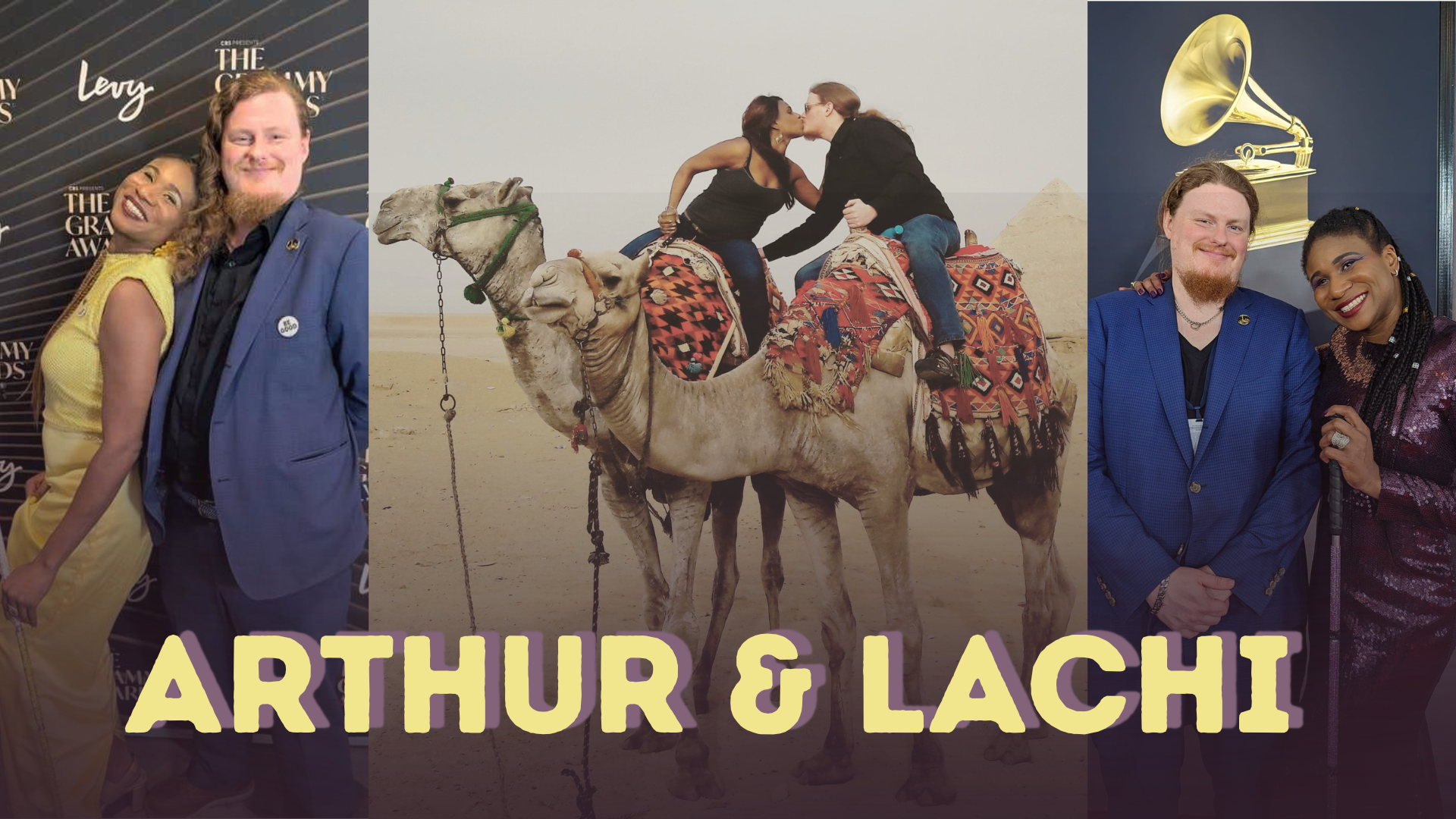
I’m Arthur—a big and tall white guy with way too much red hair, and I identify as neurodivergent.
Folks in the music community may know me for my operations role at RAMPD (Recording Artists and Music Professionals with Disabilities). Founded by award-winning recording artist, author and culture leader Lachi, we’re a disability-led consultancy group and global network made up of music creatives, executives, and industry folks building accessibility and inclusion from lived experience, inside the system. But those more familiar, know me as Lachi’s business manager, sighted companion, makeup artist—and life partner.
Today, Lachi’s career centers on destigmatizing difference and amplifying Disability Culture globally through music, fashion, storytelling, and community power-building. But that wasn’t always the case. Before RAMPD, before joining the GRAMMY’s national Trustee board, and before writing her book I Identify as Blind and producing a Grammy-nominated project, Lachi was a behind-the-scenes indie artist/songwriting navigating an industry that wasn’t built for a blind woman of color. Meanwhile, I was navigating the director-level corporate ladder—a world notoriously unwelcoming of neurodivergence.
Lachi and I had to work through layers of internalized ableism to understand our unique strengths and access needs through love, patience, and self-acceptance, leading us to ultimately find purpose and liberation in an interdependent partnership.
Lachi and I met in college on a glee club field trip. A couple of women snuck into the Men’s Glee Club quarters because it was accurately rumored that we’d snuck alcohol onto the trip. The guys were playing card-style drinking games, and I was busy drinking everyone under the table. That is, until this quiet 5’7” girl who loved to laugh came into the room, sat across from me, and said, “Bet.” Not only did she take me down the first night, but she murdered me the second night, when we’d both started fresh. I knew back then, that her triumph wasn’t necessarily because of any kind of alcohol tolerance, but because, when she set her mind to winning, there was no stopping her.
We became good friends, dating off and on, while being supportive of each others’ New York City day-job careers. Though she was legally blind and I was neurodivergent, we never spoke about it or connected in that way. We didn’t have the terms to understand what we were masking or even the disability-awareness to understand that we were masking.
Like many disability stories, ours begins with the internalized ableism of stigmatized views and an inaccessible world.
Lachi has been legally blind since birth, navigating the world with low vision. Later in life, she was diagnosed with several neurodivergence (including OCD and ADHD) and a prognosis that she will completely lose her limited vision. For me, I was diagnosed with a hodge-podge of disorders as a child, including being misdiagnosed with bipolar. Today, I identify as neurodivergent; diagnosed as ADHD and some other behavioral – not chemical – disorders.
In the mid-twenty-teens Lachi left her job at the US Army Corps of Engineers on account of consistently not being accommodated. There was some pretty blatant intersectional oppression going on there, what with her being black, a woman, and low vision. So in her words, she “decided to recognize her worth… oh, and took the stapler.”
This only led me to be even more determined to fit in and “be easy” at my workplace despite how frustrating and energy-draining maintaining the status quo was for me, so’s to keep stability. By now, I was a director at a trade association for executive headhunting. Neither Lachi nor I were armed with the thought concept of societal ableism, and so we both (in different ways) internalized it as fact: Lachi assuming she just didn’t fit, and me doubling down on trying to fit.
In 2015, we both got ordained so we could help get all of our gay friends married real quick. We then looked at each other like, “what do you think?” And decided we wanted a domestic partnership, because if they ever took marriage away from any group, we didn’t want to have what our friends couldn’t get; also, we wanted to wake up every day choosing each other, not by law, but by heart. We became domestic partners on March 14, 2015 at 9:26, with the notary stamping right at 53 seconds, because 3.141592653 is pi, and both of our nerdinesses run that deep.
Lachi began releasing dance music with independent producer and label clients using marketplaces like Soundbetter. This was no small feat. Lachi was not yet navigating with a cane, so with each studio she visited in New York City, she had to get acquainted with its ins and outs, learn the most accessible route to the bathroom (where she may trip over wires, or slip on a mopped floor), and which sighted person to trust enough to ask for assistance without appearing non-competitive.
As cool as it was that she was single-handedly building her music career, I was simply too drained from the commute to my corporate gig, too frustrated from interpersonal office gymnastics, and just too overstimulated to truly support, even emotionally. Because of this we were both treading life just above water, stressed, and exhausted.
After Lachi got signed to an EDM music management firm as a songwriter, the work and the dance of masking became overwhelming, so she began building her own home studio, rigging everything to fit her ergonomic and spatial needs, setting presets and keyboard shortcuts to taste, and implementing screen magnifiers, text-to-speech, and other assistive tools that allowed her to navigate the studio with ease.
Suddenly she was making money and hiring an assistant, our first tangible self-accomodation win! But though my literal job description entailed helping manage teams and books, I did not have the energy to lend when Lachi came to me with questions. She would spend hours navigating inaccessible bookkeeping tools on tasks that would have taken me a minute, if I had the mental wherewithal. I also lacked the social will, and was too fearful to accompany her to late night networking meetings and shows. She would miss deal-making hand shakes at the dark galas, and I could have helped her avoid that.
Then COVID hit, and Lachi was in a uniquely prepared position with her home studio. Artists were scrambling as studios shut down, but Lachi kept her momentum going and even began recording other artists at her spot. With a studio set up that fit her needs, Lachi was writing, recording, and producing twice as fast and with far more confidence than ever. Her accommodating her disability, now made her a fricken beast!
I also found myself thriving during the shutdown. With the office moving to remote work—no overstimulating commute, no spoon-draining small talk, no masking for the normies—I found myself awash with boundless energy. And with an improved mental state and mood, and a self-built home office of my own, my productivity skyrocketed. So this time when Lachi came to me with questions on how to manage her business, I was ready, willing and excited to accept the challenge.
She brought me on as her part-time business manager, and I watched as her brewing success manifested into self-confidence and open acceptance of her disabilities and neurodivergences. She began speaking up about her blindness, and the lack of disability representation in the music industry, starting with her virtual panel at Women In Music, and the now-historic Recording Academy panel opposite GRAMMY’s leadership that eventually led to the creation of RAMPD. These panels eventually blossomed into talks and keynotes in the entertainment industry and corporate world on inclusive work cultures, accessible design, and disability pride. And while it was such a thrill supporting Lachi first-hand through the growth, I was all the while still working my remote day-gig, still not comfortable enough to request workplace accommodations of my own.
Here I was on the inside booking the gigs, bejeweling the Glamcanes she was now proudly touting, and doing her makeup (going viral several times over on Reddit for her makeup looks), watching everyone from an individual colleague to a large crowd be affected by her message of celebration and joy. I was privileged to witness the power of self-acceptance work for Lachi first hand. But it wasn’t until sometime in early 2022 that it clicked for me.
I am neurodivergent. Yes, I was misdiagnosed as a kid, yes I was misunderstood growing up, yes I compensated by hiding what society told me was wrong. But I decided, I was done with all that. My difference and lived experiences are an asset, and when I’m accommodated, I am a fucking wizard.
In mid 2022, I left my job to bring my full energy to managing Lachi’s business, traveling the world, and creating meaningful music and inclusive content with international brands. I take on the physical navigation, she takes on the social navigation, and together we take on the societal navigation.
A quick tangent on the term interabled. Some folks use the term ‘interabled’ to refer to a couple where one person has a disability and the other doesn’t. I feel the term inter-abled is riffing off the term interracial—yet another example of a movement “borrowing” from the Black movement. The term “interracial” stemmed from when such relationships were illegal, so I believe it uncomfortably mirrors that for a lot of couples who are unable to marry today, either because of antiquated laws around consent or conservatorship, the history of disabled people being sterilized, and that a lot of couples in the U.S. must avoid marriage because changing their status may affect access to lifesaving healthcare benefits.
Lachi has a strong aversion to the term as well, as she believes everyone has Disability identity (i.e. one person may be in a wheelchair, and their partner may not, but do they not have ADHD, depression, chronic muscle pains, or some other non-visible difference that makes the world not perfectly build for their body-mind?), and that using the term introduces a human imbalance within what should be an equitable relationship, leading to a potential slippery-Charity Model-slope of “we ourselves believe one of us should be pathologized but not the other”.
If someone saw Lachi and I walking down the street, she with her cane and me guiding her by her arm, they could potentially label us interabled, with her being the disabled of the two-of us. But, in viewing disability through the Social Model lens (we are impaired by social and physical barriers, not by our natural body-minds), anyone can see that Lachi is the one doing the life-guiding, talking to the humans when I don’t have the energy or am overstimulated, and creating a safe, accessible environment for the both of us so we can thrive. We are not interabled, we are interdependent.
We are just one of the many examples of how prioritizing self-acceptance and honoring accommodations in a relationship really allow people in all walks of life and stages in their careers to flourish and truly contribute to the betterment of our world in the way only they (and the mind and body with which they came) can. A life of navigating a world that was not built for us made us both creative, innovative and driven, powerful traits we were able to explore, once our access needs were met.
It was like Lachi and I had fallen in love for the first time all over again—this time a proud interdependent partnership—a blind woman with cornrows and a neurodivergent white guy with way too much red hair.
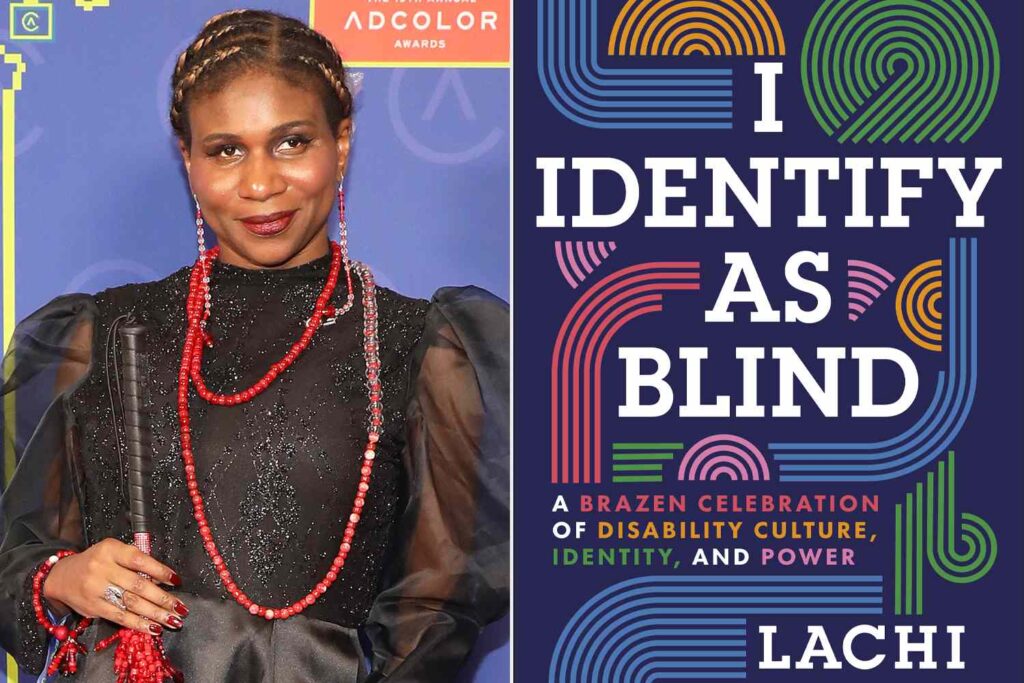
Learn more about Lachi and her life as a blind woman in her book, “I Identify as Blind.”